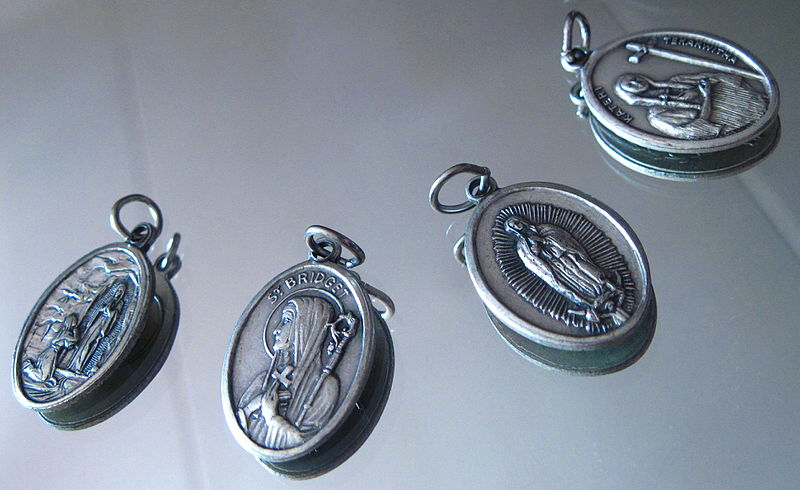
Four Catholic devotional medals By GrammarFascist (Own work) [CC BY-SA 4.0 (http://creativecommons.org/licenses/by-sa/4.0)], via Wikimedia Commons
Devotional medals are pieces of metals, often worn around the neck, struck to commemorate some aspect of Catholic religion, either a person (Christ, the pope, a saint), a place (churches or shrines) or an idea. They exist to remind the wearer of his or her faith in God, to offer a way to communicate with God and to strengthen one’s beliefs.
The use of amulets for protection was widespread among pagans. Early Christian leaders adapted this practice in the form of small metal objects, often in the shape of crosses or coins. These coins would be stamped with an image on either one or both sides, often of a saint or shrine. This practice continued into the Middle Ages, but it is unknown how widespread it was due to lack of records. The earliest mention of medals struck for a specific reason is found in the 12th century. At this time, pilgrims received tokens cast in lead as a sign that they had visited a famous pilgrimage site. These “pilgrim signs” were often worn on the breast or hat. By the Renaissance in the 14th century, medals used specifically for religious devotion were being struck in Italy. They were made to represent saints or shrine and to commemorate papal jubilees. Eventually, indulgences were attached to particular medals. By the 17th century, the practice had spread to all of Catholic Europe and most cities had craftsmen capable of producing medals.
In the centuries since they were developed, hundreds of varieties of medals have been produced. Although it is impossible to classify all of these medals, several types have become common. Plague medals were struck and blessed as protection against pestilence. Their subjects often included St. Sebastian, St. Roch or shrines of the Blessed Virgin Mary. Medals commemorating Miracles of the Eucharist are struck in the place where the miracle occurred to commemorate jubilees and centenaries of the miracles. Private medals are struck to commemorate events in the life of an individual, such as baptism, marriage or first communion. Papal medals have been struck since Pope Martin V in 1417 to commemorate important events during a pontificate, most often the opening and closing of the Holy Doors in a Jubilee year.
The use of amulets for protection was widespread among pagans. Early Christian leaders adapted this practice in the form of small metal objects, often in the shape of crosses or coins. These coins would be stamped with an image on either one or both sides, often of a saint or shrine. This practice continued into the Middle Ages, but it is unknown how widespread it was due to lack of records. The earliest mention of medals struck for a specific reason is found in the 12th century. At this time, pilgrims received tokens cast in lead as a sign that they had visited a famous pilgrimage site. These “pilgrim signs” were often worn on the breast or hat. By the Renaissance in the 14th century, medals used specifically for religious devotion were being struck in Italy. They were made to represent saints or shrine and to commemorate papal jubilees. Eventually, indulgences were attached to particular medals. By the 17th century, the practice had spread to all of Catholic Europe and most cities had craftsmen capable of producing medals.
In the centuries since they were developed, hundreds of varieties of medals have been produced. Although it is impossible to classify all of these medals, several types have become common. Plague medals were struck and blessed as protection against pestilence. Their subjects often included St. Sebastian, St. Roch or shrines of the Blessed Virgin Mary. Medals commemorating Miracles of the Eucharist are struck in the place where the miracle occurred to commemorate jubilees and centenaries of the miracles. Private medals are struck to commemorate events in the life of an individual, such as baptism, marriage or first communion. Papal medals have been struck since Pope Martin V in 1417 to commemorate important events during a pontificate, most often the opening and closing of the Holy Doors in a Jubilee year.
 RSS Feed
