Key Thoughts
  • Home
105 Market St.
Mount Clemens, M
586-468-4578

www.stpetermtclemens.weconnect.com

Catholic Culture: The Angelus

7/18/2017

Comments

 
Picture
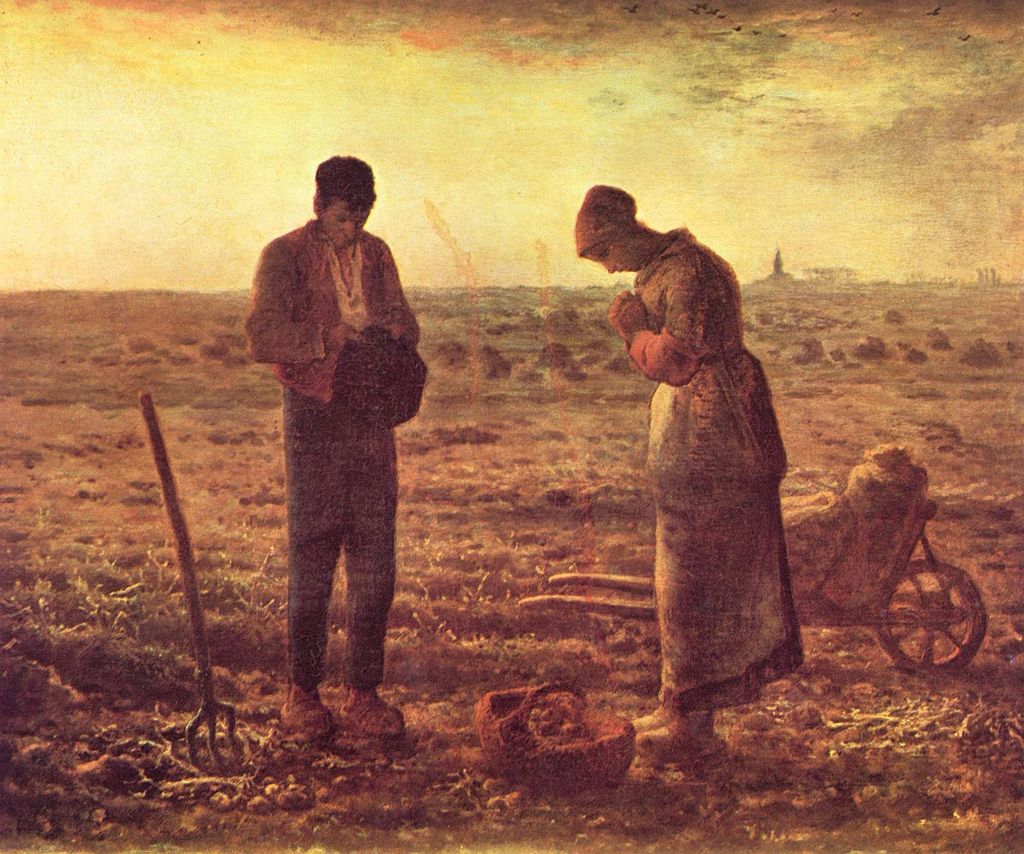
The Angelus by Jean-Francois Millet
The Angelus is a Catholic devotion commemorating the Incarnation of Christ. The name is derived from its incipt, or opening line: “Angelus Domini nutiavit Mariae” (“the Angel of the Lord declared unto Mary.”) It takes the form of three Biblical verses narrating the mystery of the Incarnation which are recited as a versicle and response, alternating with the recitation of the Hail Mary. Traditionally, the devotion was recited in churches, convents and monasteries three times daily – 6:00 AM, 12:00 Noon, and 6:00 PM. These times were usually accompanied by the ringing of the Angelus bell, which served as both a call to prayer and a call to spread goodwill to all. This bell was rung in three sets of three strokes, with a pause between each set. In many countries – particularly Ireland, the Philippines and parts of Germany – the Angelus bell is still rung in churches or broadcast on television and radio.
 
The history of the Angelus is difficult to trace. It is certain that it was already well established 700 years ago, as the first written documentation is found in Italian monasteries in the 13th century. It is believed that it had its origins with the 11th century custom of reciting three Hail Marys during the evening, or Compline, bell. Eventually, this custom was extended to the morning, or Prime, bell as well. Recitation at noon grew out of the custom of commemorating the Passion at noon on Fridays. As a result, the custom was that Hail Marys were said to commemorate the Resurrection in the morning, the Passion at noon, and the Annunciation in the evening. Both Pope Urban II and Pope John XXII have been credited with instituting the Angelus while the triple recitation is ascribed to King Louis XI of France in 1472. By the 17th century, the form of the prayer was standardized.
 
Today, it is still customary in many places to recite the Angelus three times daily. At the lines “And the Word was made flesh / And dwelt among us”, it is common to bow or genuflect to draw attention to the moment of the Incarnation. For those who wish to begin reciting this prayer, the text is included below:
 
℣. The Angel of the LORD declared unto Mary,
℟. And she conceived of the Holy Spirit.
     Hail Mary …
℣. Behold the handmaid of the LORD.
℟. Be it done unto me according to thy word.
     Hail Mary …
℣. And the Word was made flesh.
℟. And dwelt among us.
     Hail Mary …
℣. Pray for us, O' Holy Mother of God.
℟. That we might be made worthy of the promises of Christ.

Let us pray,
Pour forth, we beseech Thee, O LORD, Thy grace into our hearts; that, we, to whom the Incarnation of Christ, Thy Son, was made known by the message of an angel, may by His Passion and Cross be brought to the glory of His Resurrection. Through the same Christ our Lord.
​
℟. Amen.
Comments

Catholic Culture: LIturgy of the Hours

7/11/2017

Comments

 
Picture
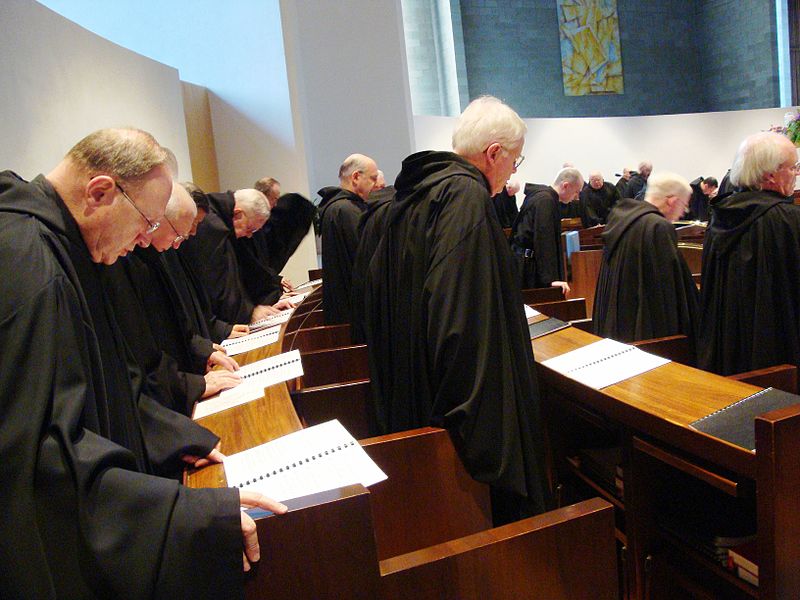
Benedictine monks singing Vespers on Holy Saturday by John Stephen Dwyer [CC BY-SA 3.0 (http://creativecommons.org/licenses/by-sa/3.0)], via Wikimedia Commons
The Liturgy of the Hours, also called the Divine Office or Work of God, is the official set of prayers “marking the hours of each day and sanctifying the day with prayer.” (USCCB, “Liturgy of the Hours”) It consists primarily of psalms supplemented by hymns, readings and other prayers and antiphons. Along with the Mass, the Liturgy of the Hours forms the official public prayer life in the Church. As such, priests and transitional deacons are obligated to celebrate it each day. Permanent deacons are obligated to celebrate only that part of the Liturgy designated by their episcopal conference. Religious communities generally require their members to celebrate the Liturgy at least in parts, often doing so jointly (referred to as “in choir”). While the laity are under no obligation to celebrate the Liturgy of the Hours, they are encouraged to recite it.
 
The Liturgy of the Hours has formed part of the Church’s public worship from the earliest days of Christianity and continues to be celebrated by Christians of both Eastern and Western traditions. Its origins come from the Jewish practice of reciting prayers at certain hours of the day. Early Christians continued this practice, with Acts recording that the Apostles prayed at the third, sixth and ninth hours and at midnight. These prayers originally consisted of reciting or chanting psalms and reading from the Old Testament. Readings from the New Testament and canticles were soon added. As monasteries were formed, the Liturgy of the Hours took on a more defined form. By the 5th century, it was composed of seven hours each celebrated at a specific time: Matins (during night or at midnight), Lauds (at dawn or 3 AM), Terce (3rd hour, approx. 9 AM), Sext (6th hour, approx. Noon), None (9th hour, approx. 3 PM), Vespers (“at the lighting of the lamps,” approx. 6 PM), and Compline (before retiring, approx. 9 PM). In the 6th century, St. Benedict added an eighth hour – Prime (1st hour, approx. 6 AM).
 
While the psalms and prayers recited during the Liturgy of the Hours were adjusted over time, the basic structure of hours of the Traditional Roman Breviary remained unchanged until Vatican II. After Vatican II, Pope Paul VI promulgated a new Roman Breviary which modified the structure of the hours and the distribution of prayer and psalms. It also introduced the idea of “major” and “minor” hours. Major hours contained more psalms and prayers and took longer to recite than minor hours. The new structure consisted of the major hours – Office of Readings (formerly Matins), Lauds or Morning Prayer and Vespers or Evening Prayer – and minor hours – Daytime Prayer (consisting of one or all of Terce or Mid-Morning Prayer, Sext or Midday Prayer and None or Mid-Afternoon Prayer) and Compline or Night Prayer.
 
The beauty of the Liturgy of the Hours comes from its continuous nature. Following the cycles, it reflects the rhythm of the day from praise in the morning to thanksgiving in the evening and self-examination at night. It is truly one of the most beautiful prayers of the Church. It truly is the Church constantly praying for the entire world.

Comments

"Angelus" During the Easter Season

5/2/2017

Comments

 
Picture
The Angelus by Jean-Francois Millet
During the Easter season, the words of the hymn "Regina Caeli" ("Queen of Heaven") are substituted for the Angelus prayer:
Queen of Heaven, rejoice, alleluia!
Because the son you were chosen to bear, alleluia!
​Has risen, as he said, alleluia!
Pray for us to God, alleluia!
Rejoice and be glad, O Virgin Mary, alleluia!
Because the Lord is truly risen, alleluia!
O God, who by the resurrection of your Son, our Lord Jesus Christ, granted joy to the whole world, grant, we beseech you, that through the intercession of the Virgin Mary, his Mother, we may enjoy the happiness of eternal life, through the same Christ Our Lord. Amen.

Old timers will tell of how "the horses stopped to pray" when the Angelus bell rang.

Back when horses pulled the plow, the farmer would bring them to a halt when the church bell rang so that he could pray the Angelus. The horses became accustomed to this and would stop on their own at the sound of the bell. Some farmers say that the horses even bowed their heads during the prayer.

- Little White Book, Diocese of Saginaw

Comments

Catholic Culture: Litany

4/25/2017

Comments

 
Picture
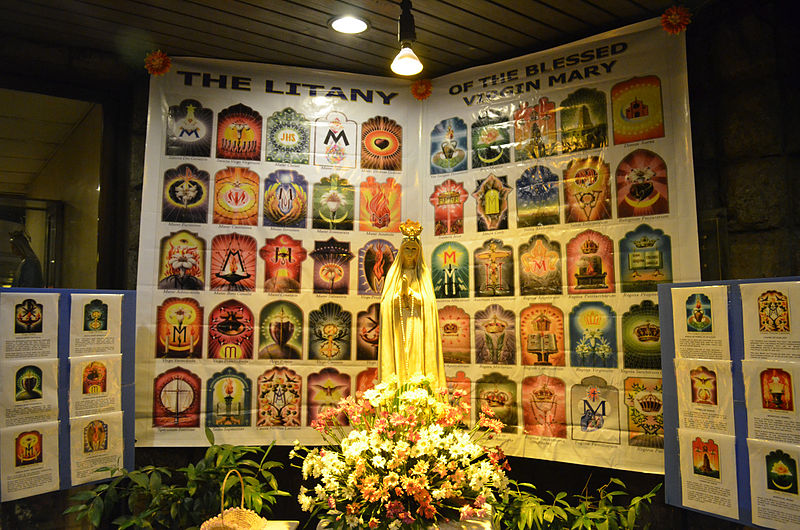
By NoslivRage (Own work) [CC BY-SA 3.0 (http://creativecommons.org/licenses/by-sa/3.0)], via Wikimedia Commons
A litany is a form of prayer used in services and processions. It consists of a number of petitions and usually takes the form of a petition read by the leader with a response by everyone else. The name comes from the Latin litania via the Greek lite meaning “supplication.” The original form of the litany was probably the frequent repetition of the Kyrie, which was in use in Asia and Rome from a very early date. The number of repetitions was dependent on the celebrant. It is still used today at the consecration of a church while the relics to be placed in the altar are carried in procession around the church.

In the 5th century, public devotions and processions became more frequent and took the name litany. In Rome, the pope and the people would go on procession to a different church each day, especially during Lent. This is the origin of the Roman “Stations” during Lent and the “Litania Major” which takes place on April 25. Each of these features a procession during which the Litany of the Saints is recited.  In 477, the “Litania Minor”, which took place the week before the Ascension, was introduced in France to pray for fewer earthquakes and calamities. A similar litany was held in Spain the week after Pentecost.
​
Because of their popularity, numerous variations of the litanies were developed. These included litanies in honor of God the Father, God the Son, God the Holy Ghost, the Precious Blood, the Blessed Virgin Mary, the Immaculate Conception, various patron saints, the souls in Purgatory and more. By 1601, there were about 80 different litanies in publication. Consequently, and to prevent abuses, on September 6, 1601 Pope Clement VIII forbade the publication of any litanies other than the Litany of the Saints and the Litany of Loreto (also known as the Litany of the Blessed Virgin Mary). Later, litanies of the Holy Name of Jesus, the Sacred Heart, the Precious Blood and St. Joseph were approved for use. Other litanies are used in private prayer but are not approved for public recitation.

Comments

Catholic Culture: Chaplet of the Divine Mercy

4/18/2017

Comments

 
Picture
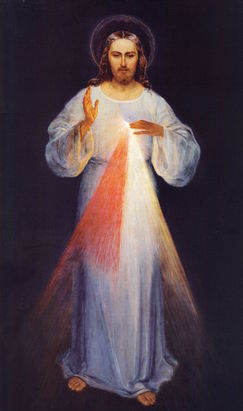
The Chaplet of the Divine Mercy is a Christian devotion to the Divine Mercy. It is based on apparitions of Jesus reported by St. Faustina Kowalska, Polish mystic and religious sister of the Congregation of the Sisters of Our Lady of Mercy. The chaplet is often said as a rosary-based prayer which uses the same set of beads that are used to recite the Holy Rosary. The chaplet is about a third of the length of the Rosary, and its structure has remained unchanged since St. Faustina received it. It can also be recited without the use of beads and is often accompanied by veneration of the Divine Mercy Image.

On September 13, 1935, St. Faustina recorded in her diary that she had a vision of Jesus during which he asked her to pray the chaplet and instruct others to do so. According to her diary, the chaplet’s prayers for mercy are intended to obtain mercy, to trust in Christ’s mercy and to show mercy to others. St. Faustina wrote that Jesus promised that all who recite this chaplet at the hour of death or in the presence of the dying will receive great mercy.

Traditionally, the chaplet may be said at any time, but it is said especially on Divine Mercy Sunday (the Sunday after Easter) and Fridays at 3:00 PM (the hour Jesus died by crucifixion, called the Hour of Mercy). As a novena, it is usually said each of the nine days from Good Friday to Divine Mercy Sunday. St. John Paul II was instrumental in extending the devotion to the Divine Mercy worldwide and promoted it in a Papal Blessing in 2001.

For more information about the Chaplet of the Divine Mercy and how to pray it, visit the USCCB page. 

Comments

Tips About Prayer

4/9/2017

Comments

 
Picture
Image by MD. Hasibul Haque Sakib on flickr.com https://creativecommons.org/licenses/by-nc-nd/2.0/legalcode
It's hard to pray when you are sick or in crisis.

You'd think these would be the easiest times to pray. But it is a common experience that even though these are times when we most want to pray, it's usually most difficult. Don't let it worry you. Go to the basics. For example, simply pray the Our Father slowly over and over. (There's a lesson here. Don't say, "I'll pray when I really need it." Pray when you're not in crisis.)

Don't let prayers get between you and God.

The object of praying is not just saying prayers. It is being with God. The different forms of prayer are simply means to open ourselves up to God's presence. Too often we confuse "praying" with "saying prayers."

The more we pray, the more we want to pray. The less we pray, the less we want to pray.

Here is where prayer is different from many other things in life. Like food. Eating the same thing day after day dulls our taste for it. Prayer is just the opposite. Repeated prayer whets our appetite. With prayer, absence does not make the heart grow fonder. It makes the heart grow inattentive.

"O Lord, hear my prayer, O Lord, hear my prayer, When I call, answer me."
                                                                  - Prayer of Thomas Merton


- Little Black Book, Diocese of Saginaw

Comments

Tips About Prayer

4/2/2017

Comments

 
Picture
Grace by Eric Enstrom
There is a good indicator that your prayer is "working."

The indicator is this: You begin to notice more the presence of God in the world around you and in the routine of your day. That's a good sign. (Besides, it's healthy because now you are seeing things as they are ... because God is present in all these things.)

When you pray, pray.

This applies mostly to "public prayers" - grace before meals, a prayer before meeting, singing a hymn. Don't "perform" the prayer for others to hear, or simply to do it because you're supposed to pry. Pray it. Consciously remind yourself that you are talking directly to God.

Don't force your kind of praying on someone else, or let someone else do this to you.

There are a thousand ways to pray. If it tastes good, eat it. If not, try something else. This is why communal prayer should draw upon the most basic forms of prayer. They have the widest appeal. Planners and leaders should not impose their own tastes upon the group.
​
"It's your Church, Lord. I'm going to bed." - St. John XXIII's prayer after a long day

- Little Black Book, Diocese of Saginaw

Comments

Tips About Prayer

3/26/2017

Comments

 
Picture
Image by Michael Dorausch on flickr.com https://creativecommons.org/licenses/by-sa/2.0/legalcode
Just because you more time to pray doesn't mean you will pray more.

It can be hard to carve out time for prayer. But when you have more time, it still takes some effort to move into prayer.

Talk straight to God, and talk about everything.
​
This is similar to "pray your feelings." No subject is inappropriate for prayer. Talk about everything - everything. When we die, we come to the Lord as we are, the good and the bad.

We would not want to have too many difficult things that we have to talk over for the first time with the Lord.

"Does God have a set way of prayer, a way that he expects each of us to follow? I doubt it. I believe some people - lots of people - pray through the witness of their lives, through the work we do, the friendships they have, the love they offer people and receive from people. Since when are words the only acceptable form of prayer?" - Dorothy Day

- Little Black Book, Diocese of Saginaw

Comments

Tips About Prayer

3/19/2017

Comments

 
Picture
Image by Terri Lynne Underwood on flickr.com https://creativecommons.org/licenses/by/2.0/legalcode
Don't pass up unexpected or unscheduled moments of prayer.

Sometimes, without intending it, we naturally drift into prayer. It comes upon us at an unexpected moment. Don't put those times on "hold" as though you can retrieve them later. Go with it, however brief this time may be.

Some of the best experiences of prayer happen this way.

Something doesn't have to "happen" every time we pray.

Don't look for immediate results. Prayer is "being with" God. The results are real but gradual. Every session of prayer is not meant to produce a new thought, a new resolution, a bottom line result.

That, by the way, is one of the things that can help make times of prayer enjoyable.

"Work as if you were to live 100 years, pray as if you were to die tomorrow." - Ben Franklin

- Little Black Book, Diocese of Saginaw

Comments

Prayer Labyrinth

3/16/2017

Comments

 
Picture
Image by QuesterMark on flickr.com https://creativecommons.org/licenses/by-sa/2.0/legalcode
A prayer labyrinth is a specially designed maze in which a person mediates and prays while walking a specific path from the edge to the center and back to the edge again.

The oldest evidence of a Christian labyrinth can be found in a mosaic at the ancient Basilica of Reparatus in Orleansville, Algiers, that dates back to the fourth century. In the Middle Ages, prayer labyrinths grew in popularity across Europe (since it was too dangerous to travel to the Holy Land at the time). Folks would walk a "journey to Jerusalem" at a nearby cathedral on its labyrinth (many of which were dedicated to Mary).

One of the most famous prayer labyrinths can be found in the Cathedral of Chartres in France.

- Little Black Book, Diocese of Saginaw

Comments
<<Previous

    ABOUT

    St. Peter Parish is a Roman Catholic faith community.  The purpose of this blog is to help parishioners and community members come to a better understanding of our Catholic faith and traditions.


    For more information about the parish, visit our website.


    Spotify Top Christian Tracks


    Archives

    June 2017
    May 2017
    April 2017
    March 2017
    February 2017
    January 2017
    December 2016
    November 2016
    October 2016
    May 2016
    April 2016
    March 2016
    February 2016
    January 2016
    December 2015
    November 2015
    October 2015
    September 2015
    August 2015
    July 2015
    June 2015
    May 2015
    April 2015
    March 2015
    February 2015
    January 2015
    December 2014
    November 2014

    Categories

    All
    Catholic Culture
    Catholic Teachings
    Catholic Traditions
    Church History
    Daily Readings
    Evangelization
    Feasts & Holy Days
    Gospel Reflection
    Little Black Book
    Little Blue Book
    Little Burgundy Book
    Little White Book
    Liturgical Year
    Pop Culture
    Prayer
    Saints & Heroes
    Spiritual Life
    VCAT
    What's That Word?

    RSS Feed

Powered by Create your own unique website with customizable templates.